
Somerville Wood Flooring installs herringbone wood floors in Somerville, MA, serving surrounding cities including Cambridge, Charlestown, Medford, Everett, Back Bay, along with chevron patterns and wide plank floors in white oak and pine. With 20+ years of floor work behind us, we know these floors reward precision: a herringbone pattern that starts a few degrees off square shows it at every wall, and a wide plank floor laid before it has acclimated opens wide gaps in its first winter.
Pattern and wide plank floors have become popular choices in renovated condos and older houses alike, where they suit both period rooms and modern kitchens. We help you choose the pattern, species and width, prepare the subfloor so it is flat enough for the job, lay the floor out from the room’s center, and sand and finish it in place so it reads cleanly from every doorway.
Herringbone and Chevron Patterns
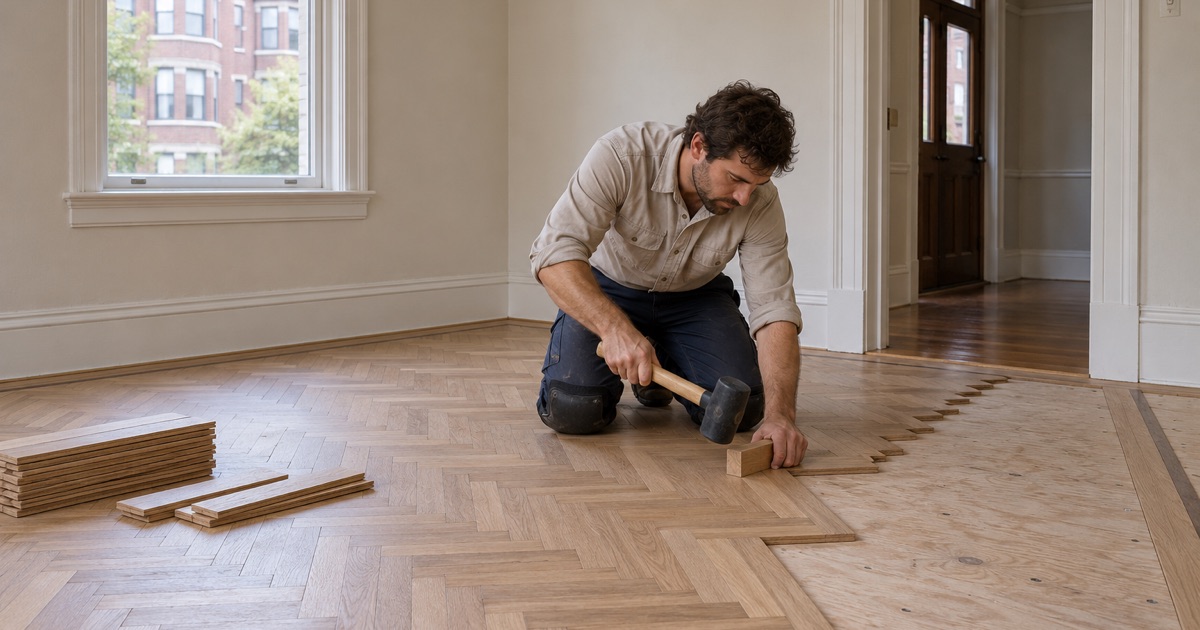
Herringbone Layout
Herringbone is laid in short rectangular pieces, each butting against the side of the next to form a stepped zigzag. Everything depends on the starting line. We snap a centerline down the room, square the first rows off it, and check the angle repeatedly as the floor grows, because a small error at the start multiplies across the room.
We plan the layout so the pattern runs the long way of the room or toward the main doorway, and so the partial pieces at the walls are balanced rather than leaving a sliver on one side.
Chevron Floors
Chevron uses pieces cut at an angle on each end so they meet in a clean point. It reads as a continuous V and suits long rooms and hallways. Every piece is pre-cut at the same angle, so accuracy in the cutting and layout is everything. Prefinished chevron is available, but site-finished chevron gives the crispest joints.
Borders and Transitions
Pattern floors often look best inside a border of straight boards around the room’s edge, which frames the pattern and hides small variations at the walls. Where a herringbone floor meets an existing strip floor at a doorway, we plan a threshold, border or deliberate transition so the change looks designed.
Herringbone in Old Houses
A herringbone floor can go into a renovated room of an older house as well as a new condo, but old subfloors are rarely flat enough as they stand. We often lay new plywood over the original boards to give the pattern a flat, stable base, then plan door trimming and transitions for the added height. In a stacked two-family, we schedule the cutting around the household above or below.
Wide Plank Floors
White Oak Wide Plank
White oak is the most popular wide plank species because it is stable, takes stain evenly and wears well. Wide boards show more of the grain and fewer seams, giving a calmer, more open floor. In solid form, wide white oak needs careful acclimation and fastening; in engineered form, it is far more stable.
Wide Plank Pine
Wide pine boards are the traditional floor of older New England houses, and new wide pine suits renovations that want to echo them. Eastern white pine is soft and dents with use, which many owners like as part of the look. We fasten wide pine in the traditional way where suitable, including face nails, and finish it to bring out its warmth.
Movement and Acclimation
A wider board moves more across its width as humidity changes through the seasons. We let wide plank material acclimate in the rooms where it will go, read it and the subfloor with a moisture meter, and install when they are within range of each other, following the NWFA Installation Guidelines.
Subfloor and Installation
A Flat Subfloor
Pattern floors and wide boards both show every dip and hump in the subfloor below. We check flatness across the room, fasten loose areas, plane high spots and fill low ones before any flooring goes down, because no amount of sanding fixes a pattern that rocks.
Gluing and Fastening
Herringbone and chevron pieces are usually glued and pin-nailed or cleated to the subfloor, since the short pieces have little length to hold a fastener. Wide plank is typically glued and nailed, with fastener spacing adjusted for the width. Very wide solid boards may also be face-nailed or screwed and plugged near the ends, which holds them flat and adds to the traditional look.
Condos and Sound Underlayment
In a condo, the association may require a sound-reducing underlayment under any hard floor. We read the documents, choose an approved underlayment that works with a glued pattern floor, and schedule the work around the building’s notice and work-hour rules.
Sanding and Finishing Pattern Floors
Sanding Across Changing Grain
In herringbone and chevron, the grain changes direction every piece, so there is no single direction to sand with. We use a careful grit sequence and finish with an orbital sander to remove cross-grain scratches that would show under stain.
Stain and Sheen
We lay stain and sheen samples on the installed floor so you choose in the room’s own light. Pattern floors often look best with a natural or lightly toned finish that lets the zigzag show without heavy contrast. Because each piece catches light at a different angle, the same stain can read lighter or darker from different doorways, so we look at the samples from more than one side of the room before you decide.
Finish Choices
Waterborne polyurethane keeps white oak pale and fits the Massachusetts VOC limits for wood coatings. Hardwax oil gives a soft, matte look that suits wide plank particularly well and can be spot-repaired later. Oil-modified polyurethane warms pine and red oak toward amber, which suits a pattern floor meant to look as though it has always been there.
- 20+ Years With Wood Floors
- Written Itemized Estimates
- Free Estimates