
Somerville Wood Flooring has handled hardwood stair refinishing in Somerville, MA for 20+ years, serving surrounding cities including Cambridge, Charlestown, Medford, Everett, Back Bay. Stairs are where old houses show their age first: treads worn hollow in the middle, nosing rounded by a century of feet, paint on the risers and sometimes on the treads, and carpet runners that left a stripe of unfinished wood down the center.
A staircase is not a small floor. Almost none of it can be done with a big sander, every tread has edges, corners and a nosing, and the risers and skirt boards are vertical surfaces that have to be scraped or sanded by hand. That is why we quote stairs tread by tread rather than by the square foot, and why the price on our estimate breaks out treads, risers, landings and railings separately.
In the two-families and triple-deckers that make up much of this area, the main stairway is often shared. Common hallway stairs are the only way in and out for the households above, so refinishing them is as much a scheduling job as a sanding one. We plan the closures with every unit and write the dates down before we start.
Refinishing Treads, Risers and Nosing
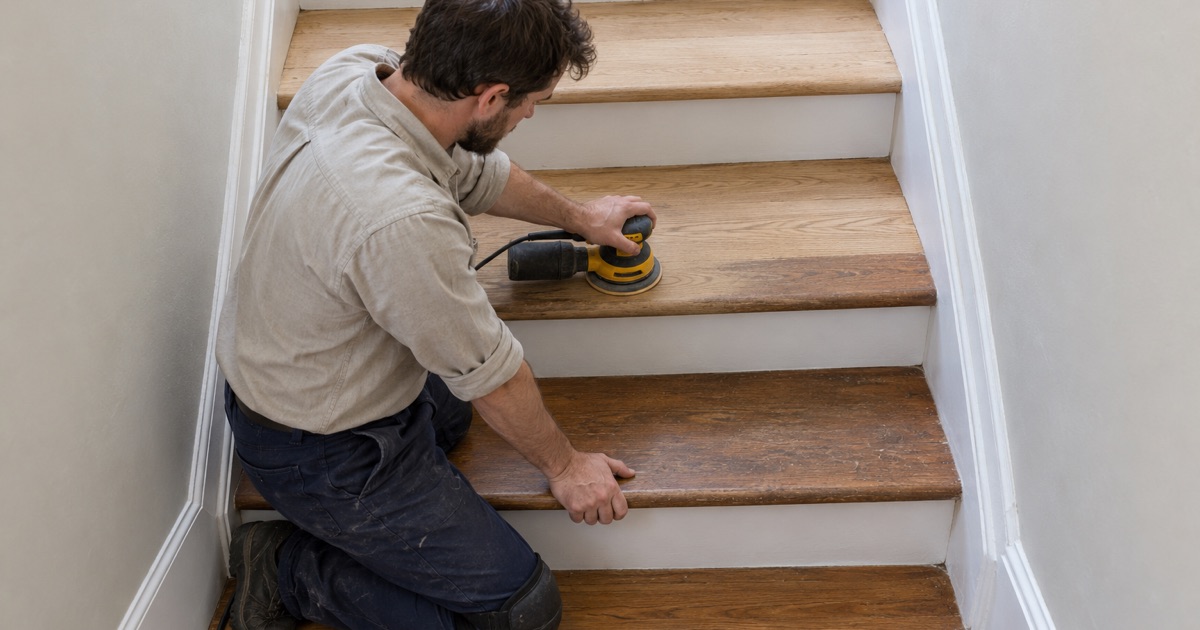
Stair Treads
Stair treads take the hardest wear in the house, concentrated in a narrow path down the middle. We sand each tread with a small machine and finish the edges and corners by hand, taking care not to round off the crisp front edge more than it already is. Treads worn deeply hollow may need more sanding than they can spare, which is when replacement becomes the better answer.
Where a carpet runner sat for decades, the wood underneath is often unworn and lighter than the exposed edges. Sanding evens that out, though some color difference can remain on very old oak, and we show you before finishing.
Stair Risers
Stair risers are the vertical boards between treads, and in older houses they are very often painted even when the treads are natural wood. You can keep them painted for contrast, which is a classic look, or strip them to match the treads where the wood allows. Painted risers are cleaned, sanded and repainted with crisp lines at the tread.
Stair Nosing and Returns
The stair nosing is the rounded front edge of each tread, and on an open staircase the nosing returns around the side. It takes more abuse than any other part of the stair and is the hardest to sand evenly. We hand-sand and scrape the profile so it keeps its shape, and replace any cracked or split nosing before finishing.
Painted Stairs and Old Finishes
Stripping Paint From Old Stairs
Many staircases in older houses were painted at some point, sometimes several times. Under the paint there may be good oak, or there may be softwood that was always meant to be painted. We test a tread before quoting, because stripping paint from paint-grade pine is a lot of work for a result that rarely looks right.
Lead Paint on Stairs
Stairs are friction surfaces, which is exactly where old lead paint does the most harm. Massachusetts runs its own lead law and deleading rules under 454 CMR 22.00, alongside the federal EPA RRP Rule. We check the build year and any painted surfaces before sanding or stripping, and set up containment and cleanup to suit what we find rather than sanding painted stairs open to the house.
Shellac, Wax and Peeling Finishes
Old stairs were often finished with shellac and waxed, and later coats of polyurethane over that wax tend to peel at the nosing first. We take each tread back to clean, bare wood so the new finish bonds, rather than adding another coat that lifts within a year.
Shared Stairways in Multi-Family Buildings
Common Hallway Stairs
In a two-family or three-family house, the front or back hall stair is often the only route to the upper units. We refinish common hallway stairs in halves, finishing alternate treads so people can still pass, or close the stair on specific agreed days when everyone has another way in. Every household gets the dates in writing ahead of time.
Landings and Hall Floors
Landings and the hall floor at the top and bottom of a staircase are usually refinished with the stairs so the color is continuous. They can be sanded by machine like a small floor, then finished in the same session as the treads.
Condo Stairways and Association Rules
In a condo, common stairs belong to the association, and the work has to follow its rules on notice and work hours. We read the association’s documents and plan the job to them, rather than assuming what is allowed.
Repairs, Replacements and Carpet Removal
Replacing Damaged Treads
Cracked, split, burned or deeply worn treads can be replaced individually with matching wood. We cut the new tread to fit the existing stringer and riser, match the nosing profile, and stain it to sit beside the old treads.
Squeaky Stairs
Squeaks on stairs usually come from a tread moving on its riser or stringer. Where we can reach from below, we glue and block the joint; from above, we fasten through the tread into the riser and fill the holes. Fixing squeaks is easiest before refinishing, while the treads are bare.
Converting Carpeted Stairs to Wood
Pulling carpet off stairs reveals carpet pad, tack strip and dozens of staples per step. We remove all of it, check whether the treads underneath are finish-grade, and either refinish them or install new stair treads and risers over the old ones where they are not.
Our Step-by-Step Hardwood Stair Refinishing Process
Step 1: Look at Every Step
We check each tread for species, thickness, cracks and wear, test any paint and the old finish, and note the build year. The estimate lists treads, risers, landings, repairs and railings line by line, with the closure days for a shared stair written in.
Step 2: Contain and Prepare
The stairwell is sealed off from the rest of the house with plastic at the top and bottom, returns are covered, and HEPA vacuums run on every sander. Loose treads are fastened, squeaks are fixed, and damaged treads or nosing are replaced while the stair is bare.
Step 3: Sand, Scrape and Stain
Treads are machine-sanded where the machine fits and hand-sanded and scraped everywhere else, through the full grit sequence. Stain, if chosen, goes on after a sample has been approved on a tread in the stairwell’s own light.
Step 4: Finish in Sequence
Finish coats go on in the order agreed, alternate treads first where the stair has to stay in use. We leave written cure times and check the stair with you once the last coat is dry.
Finishes, Stain and Railings
Choosing a Finish and Sheen
Waterborne polyurethane dries quickly, keeps the wood close to its natural color, and fits the Massachusetts VOC limits for wood coatings, which matters on a staircase that every household in the building breathes around. A satin or matte sheen level is less slippery than gloss and hides wear better on a surface that sees every footstep.
Stain That Matches the Floor
Stairs are often red oak while the hall floor is a different oak or pine, so the same stain reads differently on each. We lay stain samples on a tread and on the floor so you can see both together before choosing.
Railings, Balusters and Newel Posts
Handrails, balusters and newel posts can be refinished, repainted, or left as they are. Painted balusters with stained treads and rail is a common combination in older houses. We quote railing work as its own line so you can decide separately.
- 20+ Years With Wood Floors
- Written Itemized Estimates
- Free Estimates