
Somerville Wood Flooring repairs hardwood floor water damage in Somerville, MA, serving surrounding cities including Cambridge, Charlestown, Medford, Everett, Back Bay. In 20+ years of floor work, the water damage we see most often does not start in the room that is damaged. It comes from a toilet, a dishwasher, a radiator valve or a bathtub in the unit upstairs, and it reaches your floor through the ceiling, the walls or the joist bays.
Water-damaged hardwood needs the work done in the right order: stop the source, dry the wood, measure until it is stable, document what happened, and only then repair and refinish. Skipping straight to sanding is the mistake that turns a single repair into two, because a floor sanded wet goes on moving as it dries.
We trace the water, take moisture meter readings across the floor and the subfloor, photograph and record the damage room by room for the adjuster, and write a scope that separates what can be saved from what has to be replaced. Then we do the repair once the wood is ready for it.
How Water Damages a Hardwood Floor
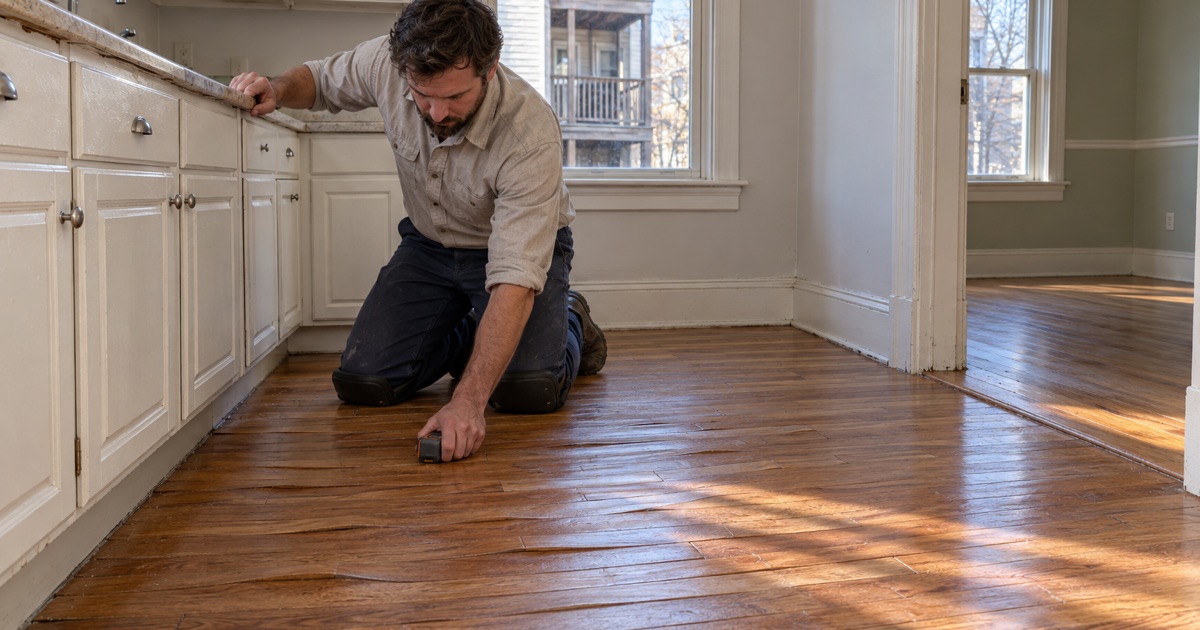
Cupping
Cupping is the most common sign of water under a wood floor. The bottom of each board takes on moisture and swells while the top stays drier, so the edges rise and the center dips. It shows first near the source and spreads along the boards, and it often appears days after the leak itself has been stopped.
Cupping is a moisture symptom, not a final verdict on the floor. Once the source is fixed and the wood dries evenly, much of it can settle back.
Crowning
Crowning is the reverse shape: the center of the board higher than its edges. It usually means a cupped floor was sanded flat before it dried, and as the bottom shrank back, the sanded top was left humped. It is a repair-timing problem, and it is the reason we wait for stable readings before touching a cupped floor.
Buckling
Buckling is the floor lifting away from the subfloor, sometimes several inches, as swollen boards run out of room and push up. It happens after heavy or prolonged water, such as a burst supply line or a leak that ran for days in a vacant unit. Buckled boards often pull their nails and split, and usually need replacing.
Water Stains
Water that sits on oak reacts with the tannins in the wood and leaves gray or black stains. Gray marks in the finish often sand out. Black stains run deep and rarely do, so stained boards are cut out and replaced.
Where the Water Comes From
Leaks From the Unit Above
In a two-family house, three-family house or condo, a leak above often travels along joists before it shows. Water stains on your ceiling, a wet patch on the floor away from any fixture, or cupping in a straight line along the boards are all signs. We trace the path so the repair addresses the right area, and note where it came from for the claim.
Radiators, Pipes and Appliances
Old steam and hot-water radiators leak at valves and vents, and their pipes run through the floor. Dishwashers, refrigerator ice lines and washing machine hoses leak slowly for weeks before anyone notices. Each leaves a characteristic damage pattern, and each has to be fixed by the right trade before the floor is repaired.
Basements, Entries and Exterior Water
Water entering at a basement wall or a back entry soaks into subfloors and the bottom of boards. Floors over damp basements can cup seasonally without any single leak. We read the moisture from below as well as above to tell a one-time leak from an ongoing condition.
Drying, Measuring and Documenting
Moisture Meter Readings
We take readings in the damaged area and in an unaffected part of the same floor for comparison, and in the subfloor wherever we can reach it. Repeated readings over days show whether the floor is drying and when it has stabilized. The repair decision follows the numbers, not the calendar.
Room-by-Room Documentation for the Adjuster
For every affected room, we record the readings, photograph the cupping, stains and buckling, measure the area, and describe what has to be replaced and what can be refinished. That written, dated record is what an adjuster needs and what a landlord or condo association can file.
When Drying Needs Other Trades
Some water damage needs professional drying equipment, plumbing repairs, or mold remediation before floor work is safe. We say so early, and we do not lay new wood over a subfloor that is still wet or showing mold.
Repairing and Refinishing After Water Damage
Replacing Boards That Cannot Be Saved
Buckled, split and black-stained boards are cut out, the subfloor is checked and repaired, and new boards are woven into the surrounding floor with staggered joints. We match the species, width and cut of the original, which in older houses is usually red oak strip or pine.
Sanding and Refinishing the Room
Once the floor is dry and stable, the room is sanded to an even surface, which flattens any remaining slight cupping and blends the new boards with the old. The finish is chosen for the household and fits the Massachusetts VOC limits for wood coatings.
Scheduling Around the Building
After a leak from above, the households involved have often already been disrupted. We schedule the floor work in your unit with doors and returns sealed against dust, and coordinate with whoever is managing the claim and the repairs upstairs.
Our Step-by-Step Water Damage Repair Process
Step 1: Find and Stop the Source
We confirm the leak has been fixed by the right trade, or help you identify where it is coming from. No floor repair starts while water is still getting in. In a stacked building that sometimes means waiting on a plumber upstairs, and we would rather wait a day than repair a floor that gets wet again the following week.
Step 2: Measure and Record
We take baseline moisture readings, photograph and measure every affected room, and give you a written record you can pass to your insurer, landlord or association. The record notes where the water came from, when it was found, and which boards are cupped, stained or lifted, so nobody has to reconstruct the story from memory weeks later.
Step 3: Dry and Re-Measure
The floor dries with the right airflow and dehumidification, and we return to take readings until the wood and subfloor are stable. Removing a few boards or a baseboard can speed drying where water is trapped underneath. We compare each reading against a dry part of the same floor, so the decision to repair rests on the floor’s own normal rather than a generic number.
Step 4: Repair and Refinish
Damaged boards are replaced and woven in, then the area or room is sanded and finished so the repair blends into the floor. Before we leave, we walk the room with you, note any area that still needs watching, and give you the finish care and curing dates in writing.
- 20+ Years With Wood Floors
- Written Itemized Estimates
- Free Estimates